 CA Sansaar


Income Tax Department Clarifies AY 2026-27 and Tax Year 2026-27 Transition Under New Income Tax Act
 Print
Print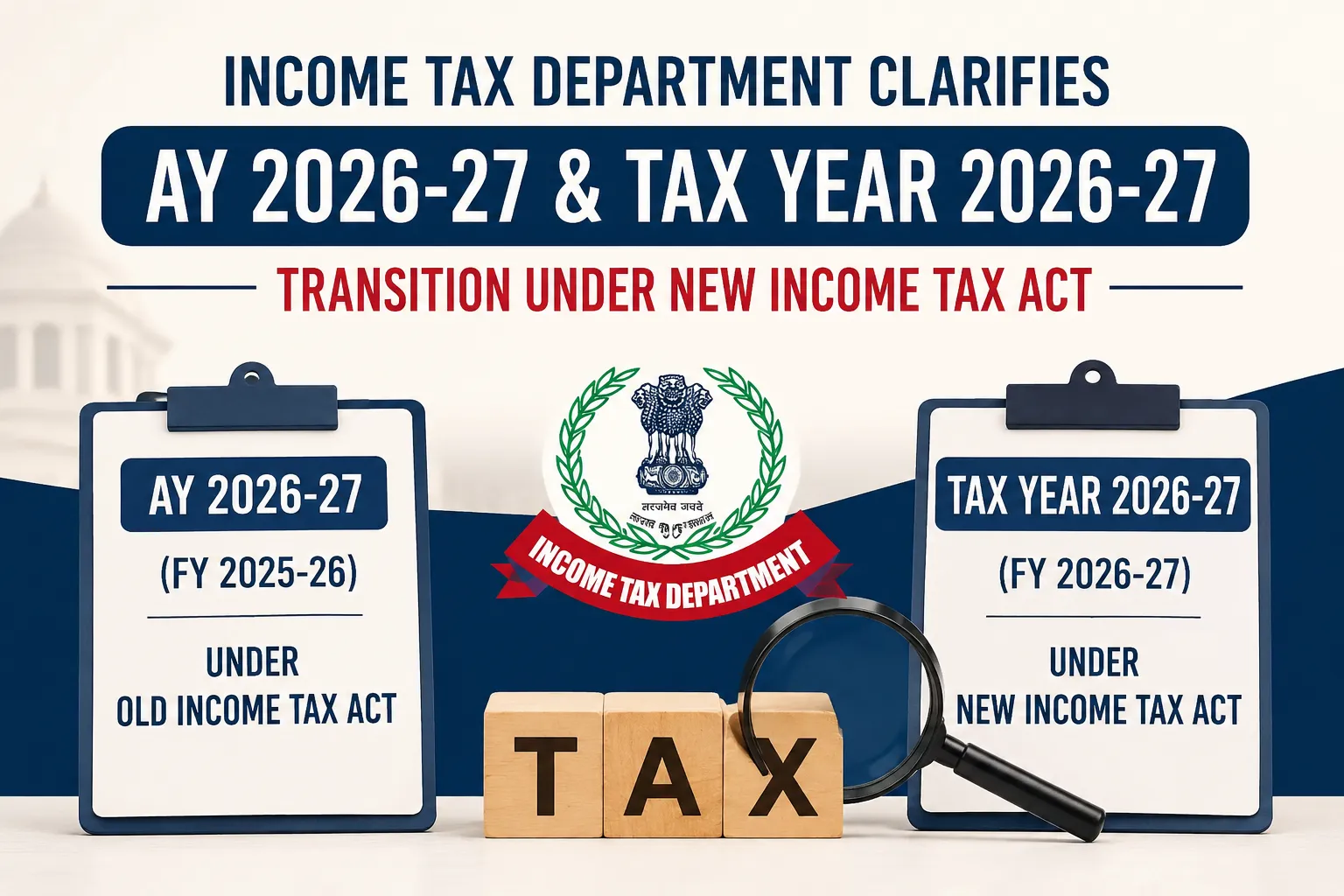
Income Tax Department Clarifies AY 2026-27 and Tax Year 2026-27 Transition Under New Income Tax Act
The Income Tax Department has issued detailed guidance clarifying the transition from the Income Tax Act, 1961 to the Income Tax Act, 2025, particularly explaining the distinction between Assessment Year (AY) 2026-27 and Tax Year (TY) 2026-27.
The clarification is important for taxpayers, Chartered Accountants, tax professionals, employers and businesses as both the old and new income-tax laws will remain relevant during the transition period, depending on the financial year in which the income was earned.
AY 2026-27 Will Continue Under the Income Tax Act, 1961
Income earned during the financial year 2025-26, covering the period from 1 April 2025 to 31 March 2026, will continue to be governed by the Income Tax Act, 1961.
Accordingly, taxpayers filing their income-tax returns for income earned during FY 2025-26 must select Assessment Year 2026-27 and comply with the provisions of the Income Tax Act, 1961.
The subsequent repeal of the old Act does not change the law applicable to such income. Returns, revised returns, belated returns, assessments, reassessments and other proceedings concerning AY 2026-27 and earlier years will continue to be governed by the old Act, subject to the applicable transitional and savings provisions.
Tax Year 2026-27 Comes Under the Income Tax Act, 2025
The concept of a Tax Year becomes applicable from 1 April 2026.
Income earned between 1 April 2026 and 31 March 2027 will be referred to as income of Tax Year 2026-27 and will be governed by the Income Tax Act, 2025.
The new Act replaces the earlier concepts of “previous year” and “assessment year” with a single expression—“Tax Year”—with the objective of simplifying terminology and reducing confusion among taxpayers.
However, this does not mean that taxpayers will have to file two income-tax returns simultaneously during the transition period.
The return for Tax Year 2026-27 will become due only after that tax year ends, broadly following the same principle under which income earned during a financial year is reported after completion of that year.
Simple Example: AY 2026-27 vs Tax Year 2026-27
The distinction can be understood as follows:
| Income Period | Applicable Reference | Governing Law |
|---|---|---|
| 1 April 2025 to 31 March 2026 | AY 2026-27 | Income Tax Act, 1961 |
| 1 April 2026 to 31 March 2027 | Tax Year 2026-27 | Income Tax Act, 2025 |
Therefore, a taxpayer filing a return in 2026 for income earned during FY 2025-26 will still file the return for AY 2026-27 under the old Act.
On the other hand, income earned from 1 April 2026 onwards falls within Tax Year 2026-27 under the new Act.
Which Law Applies to Revised and Belated Returns for AY 2026-27?
The Income Tax Department has specifically clarified that returns relating to AY 2026-27 remain governed by the Income Tax Act, 1961.
Therefore, if a taxpayer discovers an error in an original return filed for AY 2026-27 and subsequently files a revised return, the revision will continue to be governed by Section 139(5) of the Income Tax Act, 1961.
Similarly, a belated return for AY 2026-27 will continue to be governed by Section 139(4) of the old Act.
The fact that a revised or belated return may actually be filed after 1 April 2026 does not by itself bring that return under the Income Tax Act, 2025.
Self-Assessment Tax for AY 2026-27 Will Also Follow the Old Act
The Department has further clarified that self-assessment tax relating to income of FY 2025-26 remains governed by the Income Tax Act, 1961, even if the tax is actually paid after 1 April 2026.
For example, where a taxpayer pays self-assessment tax in July 2026 for income earned during FY 2025-26, the taxpayer should select AY 2026-27, and the payment will be governed by Section 140A of the Income Tax Act, 1961.
In contrast, advance tax relating to income earned during the period from April 2026 to March 2027 should be paid with reference to Tax Year 2026-27 under the new Act.
TDS and TCS During the Transition Period
The transition also affects TDS and TCS compliance.
For salary pertaining to FY 2025-26 and paid up to March 2026, TDS obligations continue under Section 192 of the Income Tax Act, 1961.
For salary relating to Tax Year 2026-27 and paid from April 2026 onwards, TDS will be governed by Section 392(1) of the Income Tax Act, 2025.
Employers are therefore required to reset their salary-TDS computations from 1 April 2026, considering projected income, deductions and the applicable tax regime for Tax Year 2026-27.
The Department has also explained that investment declarations for Tax Year 2026-27 should refer to provisions of the new Act. For example, deductions earlier associated with Section 80C will need to be referenced according to the corresponding provisions of the Income Tax Act, 2025.
Separate Information Statements for AY 2026-27 and TY 2026-27
The Department's FAQs also explain that information reporting for the two periods will be separately identified.
Information relating to FY 2025-26 and AY 2026-27 will continue to appear in the Annual Information Statement under the old framework.
For Tax Year 2026-27, the corresponding information statement under the new framework will be generated separately in Form No. 168.
This distinction is particularly important for TDS credit. Tax deducted in March 2026 will relate to AY 2026-27 under the old Act, while tax deducted in April 2026 will relate to Tax Year 2026-27 under the new Act.
Tax Audit Forms Will Also Change
The Department has clarified that tax audits relating to FY 2025-26 and AY 2026-27 will continue to use the existing Forms 3CA, 3CB and 3CD prescribed under the Income Tax Act, 1961.
For Tax Year 2026-27, however, the tax audit report will be filed through the new Form No. 26 prescribed under the Income Tax Rules, 2026.
The new Form No. 26 consolidates the earlier Forms 3CA, 3CB and 3CD into a unified tax-audit reporting form.
What Chartered Accountants and Taxpayers Should Keep in Mind
During the transition period, professionals and taxpayers should carefully identify the period to which income, tax payment, TDS, TCS, return or proceeding relates.
The key dividing line is 1 April 2026:
-
Income earned up to 31 March 2026 remains linked to AY 2026-27 or earlier and is generally governed by the Income Tax Act, 1961.
-
Income earned from 1 April 2026 onwards falls under Tax Year 2026-27 and is governed by the Income Tax Act, 2025.
-
Tax payments should be mapped to the correct AY or Tax Year to ensure proper credit.
-
Employers and businesses need to update payroll, TDS and compliance systems for the new section numbering.
-
CA firms should clearly mention the applicable Act and year in tax computations, opinions, audit working papers and representations.
The transition is therefore not merely a change in terminology. It requires taxpayers, employers, businesses and professionals to simultaneously manage compliance under two different statutory frameworks, depending on the period involved.
Category : Income Tax | Comments : 0 | Hits : 29








Comments