 CA Sansaar


GST e-way bill voluntary closure and Ship-to GSTIN changes from 1 August
 Print
Print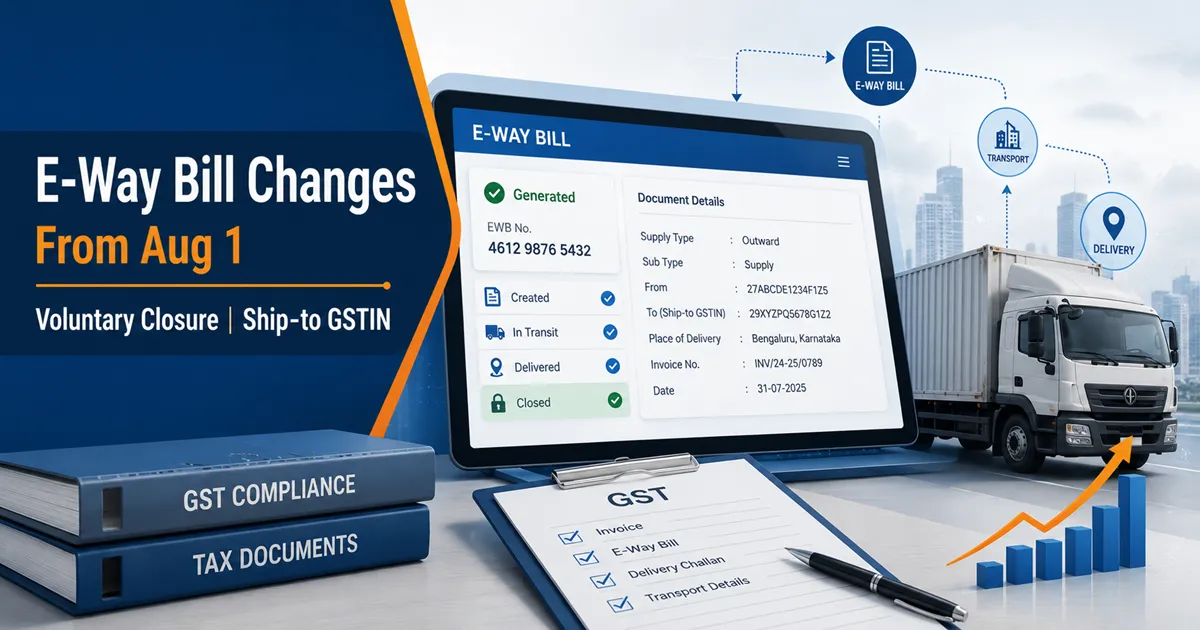
The Goods and Services Tax Network (GSTN) has announced important changes to the e-Way Bill and related e-Invoice API framework, with the revised functionality scheduled to be implemented in production from 1 August 2026. The changes mainly cover the mandatory capture of Ship-to GSTIN in specified Bill-to/Ship-to transactions and the introduction of a voluntary e-Way Bill closure facility after completion of delivery.
Mandatory Ship-to GSTIN in Bill-to/Ship-to Transactions
Under the revised system, where a transaction follows the Bill-to/Ship-to model and Ship-to details are provided, the Ship-to GSTIN will have to be captured in the relevant e-Way Bill and e-Invoice API flows. Where the Ship-to party is unregistered or a GSTIN is not otherwise applicable, the value “URP” may be entered, wherever permitted.
GSTN has also clarified that, in a genuine Bill-to/Ship-to transaction, the Bill-to GSTIN and Ship-to GSTIN should be different. The system will validate the GSTIN entered, along with related State Code and PIN Code information. Invalid GSTINs or the same GSTIN used for both Bill-to and Ship-to in such transactions may be rejected by system validations.
The changes will apply across relevant flows, including cases where:
- IRN and e-Way Bill are generated together;
- e-Way Bill is generated subsequently using an IRN;
- Bill-to/Ship-to transactions are involved; and
- transactions combine Bill-to/Ship-to with Bill-from/Dispatch-from arrangements.
Voluntary Closure of e-Way Bills After Delivery
GSTN has also introduced a new voluntary e-Way Bill closure facility. The purpose is to allow an e-Way Bill to be marked as closed once the delivery of goods has been completed, thereby creating a system record of completion of the goods movement.
The e-Way Bill may be closed by the:
- supplier;
- recipient;
- transporter involved in the transaction; or
- driver or authorised person whose mobile number has been provided for closure purposes.
For suppliers, recipients and transporters, the closure option will be available after login under the e-Way Bill section of the portal. Closure can be carried out either e-Way Bill-wise or date-wise. GSTN has also provided an API-based closure facility for ERP and system users, requiring the e-Way Bill number, closure date and remarks.
Under the earlier GSTN advisory, closure could be carried out on the day of delivery or the immediately succeeding day.
Transition Period for Closed e-Way Bills
GSTN has clarified that a separate “Closed” status is proposed to be introduced in due course. During the initial stabilisation period, the existing status framework will continue, and permitted actions such as transporter update, validity extension and vehicle updation may continue to remain available even after an e-Way Bill has been marked as closed. These relaxations are expected to be reviewed after the system stabilises.
Action Required Before 1 August 2026
GSTN has advised taxpayers, ERP vendors, GSPs, ASPs, private IRPs and other system integrators to complete testing and make necessary system changes before the production rollout on 1 August 2026. The revised specifications and related changes have already been made available in the Sandbox environment for testing and system preparedness.
The changes are intended to strengthen data integrity, improve traceability of goods movement and provide a structured mechanism for recording the completion of transactions under the e-Way Bill system.
Category : GST | Comments : 0 | Hits : 90



Comments