 CA Sansaar


GST at Its Nine Years – An Analysis: Evaluating India's Biggest Indirect Tax Reform
 Print
Print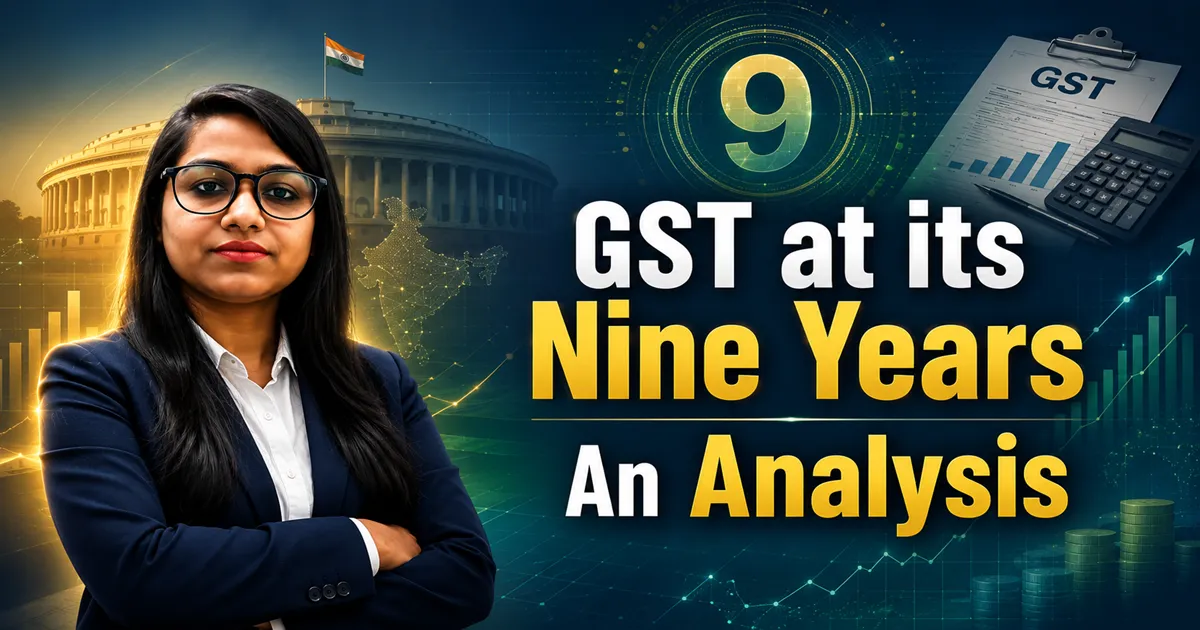
Goods and Services Tax (GST), introduced on 1 July 2017, marked one of the most significant tax reforms in India's history. Built on the vision of "One Nation, One Tax," GST replaced multiple indirect taxes with a unified taxation system. As GST completes nine years, it is the right time to evaluate whether it has truly delivered on its promises of simplified taxation, seamless Input Tax Credit (ITC), and Ease of Doing Business.
In her detailed presentation, CA Deepa Ma'am explains how GST has evolved from a tax reform into one of India's largest digital governance projects
What Was the Need for GST?
Before GST, businesses had to deal with multiple indirect taxes such as:
- VAT
- Excise Duty
- Service Tax
- Entry Tax
- Octroi
- Central Sales Tax (CST)
This resulted in:
- Tax-on-tax (Cascading Effect)
- Different tax laws across states
- Check posts causing transportation delays
- Complex compliance procedures
GST was introduced to solve these problems by creating:
- One Nation, One Tax
- Uniform Tax Structure
- Seamless Input Tax Credit
- Better Transparency
- Improved Ease of Doing Business
Nine Years of GST: Major Achievements
Over the past nine years, GST has transformed India's indirect tax ecosystem in several ways.
1. Record GST Collections
India continues to witness consistently high monthly GST collections, indicating improved compliance and expansion of the tax base.
2. Complete Digital Transformation
Today, the GST ecosystem operates almost entirely online through:
- GSTN Portal
- E-Invoicing
- E-Way Bills
- Online Refunds
- Digital Return Filing
This has significantly reduced manual intervention.
3. Formalisation of Businesses
Millions of businesses have entered the formal economy after GST implementation, improving transparency and accountability.
4. Better Invoice Tracking
Digital invoice trails have reduced tax evasion and strengthened audit mechanisms.
5. Global Recognition
India's GST framework is now regarded as one of the world's most advanced digital tax systems.
Has Compliance Become Too Complex?
One of the most important observations shared by CA Deepa Ma'am is that compliance requirements have increased significantly.
Today's businesses must regularly manage:
- GST Registration
- Monthly Returns
- Annual Returns
- Reconciliation
- E-Invoice
- E-Way Bill
- ITC Matching
- Vendor Compliance
- GST Notices
- Department Audits
Input Tax Credit (ITC): The Biggest Challenge
Despite many achievements, Input Tax Credit (ITC) remains one of the biggest pain points.
Major concerns include:
Supplier Default
If the supplier fails to file GST returns or deposit tax, the buyer may lose ITC.
Vendor Mismatch
Differences between supplier and buyer data often block legitimate credit claims.
Fake Invoices
Fraudulent invoicing has resulted in stricter verification procedures.
Working Capital Blockage
Delayed ITC directly affects cash flow, especially for MSMEs.
Ease of Doing Business: Success or Work in Progress?
Positive Outcomes
✔ Faster movement of goods across states
✔ Online registration and digital payments
✔ Reduced interaction with tax authorities
✔ Better logistics efficiency
✔ Increased transparency
Five Reforms Suggested
As discussed by CA Deepa Ma'am, GST can become even more effective through:
- Simplifying compliance and reducing return frequency
- Stabilising ITC provisions to protect genuine taxpayers
- Reducing retrospective amendments
- Strengthening dispute resolution mechanisms
- Balancing technology with human discretion
Five Reforms Suggested
As discussed by CA Deepa Ma'am, GST can become even more effective through:
- Simplifying compliance and reducing return frequency
- Stabilising ITC provisions to protect genuine taxpayers
- Reducing retrospective amendments
- Strengthening dispute resolution mechanisms
- Balancing technology with human discretion
Conclusion
Nine years after its launch, GST has undoubtedly transformed India's indirect tax landscape. It has increased transparency, expanded the tax base, digitised compliance, and improved tax administration. However, businesses continue to grapple with complex compliance requirements, ITC-related issues, frequent amendments, and litigation.
As CA Deepa Ma'am rightly points out, GST should not only be a system for collecting taxes efficiently but also a framework that supports business growth and ease of compliance. With further simplification and balanced reforms, GST can better fulfill its original promise of being a truly business-friendly tax
Watch the Complete GST Analysis by CA Deepa Ma'am
Want to understand these concepts in detail with practical examples?
Watch the complete explanation by CA Deepa Ma'am here:
https://www.youtube.com/watch?v=qnRL6CxHxxY
If you found this article helpful, don't forget to subscribe to our YouTube channel for more updates on Income Tax, GST, Company Law, and CA-related topics.
Category : General | Comments : 0 | Hits : 81







Comments